
Black Sand and a Glorious Sunday
Route
Sunday, November 8th. We woke up in Roseburg to a dreary fog, and everything outside was soaked. I was glad we got a motel. It explained something I'd been wondering about all yesterday, when the valley felt like a tinderbox and there was still moss on every tree. The fog and moisture blow straight in from the coast, and down here there's no wall of mountains like the Cascades in northern Washington to stop them.
Breakfast was at a bagel spot in Roseburg, one of the only places open early on a Sunday. They make their bagels fresh, which I respect, and the bagel was way better than a Dunkin' bagel. The bacon, egg, and cheese, though, was more Dunkin' than Long Island. It's just not the same as the one from your deli back home.
We could have saved 10 or 15 minutes on I-5, but I'd rather finish a day on the highway than start Rhea on one, so we took the back roads west. The speed limit was still 55, and we didn't see another car for 15 minutes at a stretch. Sunday morning in rural Oregon is empty. The mist hung low with the sun poking through, and we passed cattle pastures, goats, and chickens. I never really thought about what was out here; it's beautiful country.
Route 42 follows the Coquille River west toward Bandon, one road through the mountains with no houses and barely a side road. Whole hillsides had been clear-cut and replanted with what looked like young spruce. We saw three birds of prey in an hour and a half. One was definitely a red-tailed hawk, another had spotted feathers on its back, and one was on the side of the road with a kill.
We passed a flock of sheep, freshly sheared, so skinny they looked like lambs, and next to them sat a big white pile in the field. For a second, I thought it was snow, but it was 60 degrees out. It was their wool, sheared and left in a heap.
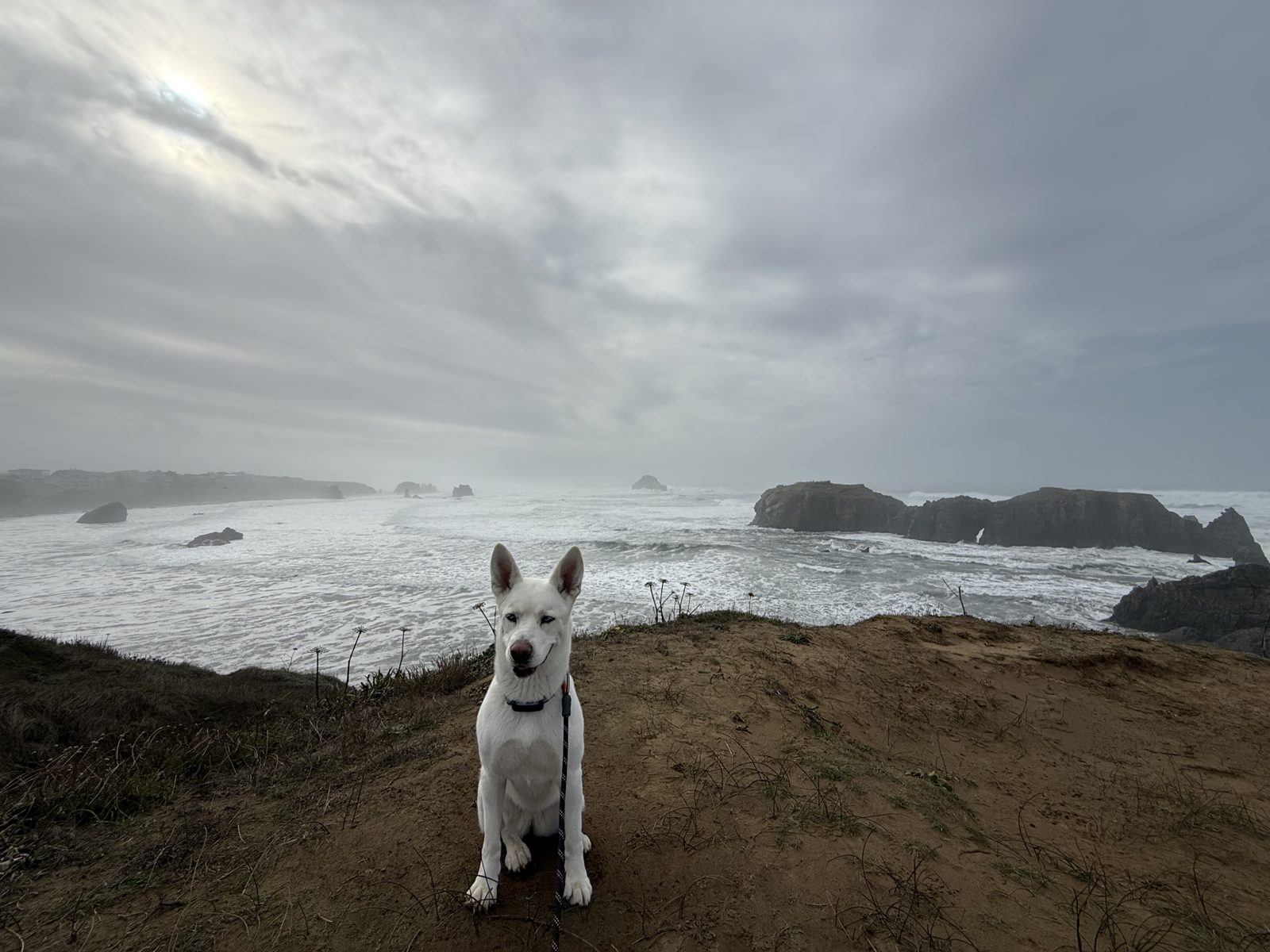
We reached the coast at Coquille Point in Bandon, part of the Oregon Islands National Wildlife Refuge. A big swell advisory was in effect, and 10- to 15-foot waves were breaking way out past the sea stacks, piling white water all the way up to the base of the cliffs. Tree trunks three and four feet in diameter were piled along the beach and getting tossed around like toothpicks. Spray shot up off the rocks, and you can smell the salt a mile inland. It's like Montauk amplified 10x. Signs for puffins were everywhere, which I never expected outside of Alaska. From May to August, tufted puffins nest on Face Rock, just off Bandon, but by November they've headed out to sea and lost their bright breeding colors.
South of Bandon, there isn't a lot on 101. Tiny coastal towns have a small market, a public library, a big thrift store, and an RV park, and 101 crosses one bridge after another over creeks and rivers draining into the ocean. Port Orford was completely empty. I get it, it's a seasonal town, but damn.
Rhea and I did a short coastal trail outside Port Orford, and it was loaded with blackberries again. They're everywhere out here, and I figured they had to be invasive, and they are. The Himalayan blackberry isn't even from the Himalayas. It's native to Armenia and northern Iran, and Luther Burbank named it the "Himalaya Giant" in 1885 after growing it from seeds sent from India. They're delicious, though.
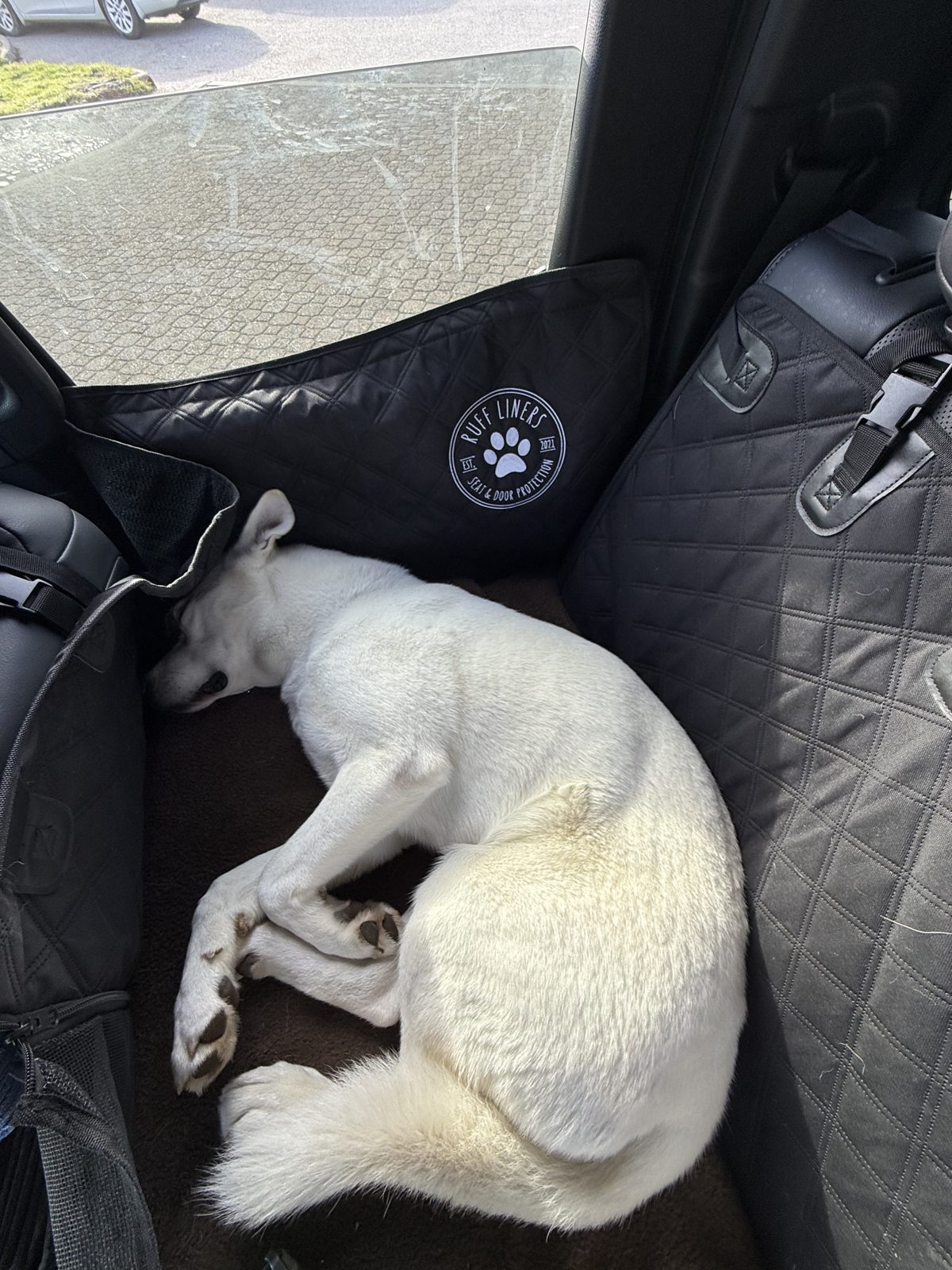
Then we sat at Battle Rock for an hour and a half. We walked around it twice, ate more blackberries, and Rhea took a long nap in the back seat while I closed my eyes and then read for a while. In June 1851, Captain William Tichenor landed nine men here to start a settlement, and they held this rock for about two weeks against the Quatomah people, whose land it was. Somewhere between a dozen and 20 Quatomah were killed before the nine slipped away north one night.
Steinbeck's one Sunday in Oregon was a bad one. A tire blew out in the mud on Rocinante, and as he put it, "it was Sunday and it was raining and it was Oregon." Ours was the opposite. It was a glorious Sunday to be alive, and on a day like this, there isn't much to be upset about.
Heading south on the winding 101, the cliffs grow in size, rugged and exposed like Big Sur, with no one living along them. I assumed the sea stacks were basalt, the harder lava rock left standing after the ocean wore the coastline back. Half right. Up north at Haystack Rock, they're basalt, but these down south are scraps of ancient seafloor rock crumpled against the coast more than 145 million years ago, left standing because the waves wore away the softer rock around them. The spray slammed into the cliffs and rose like smoke.
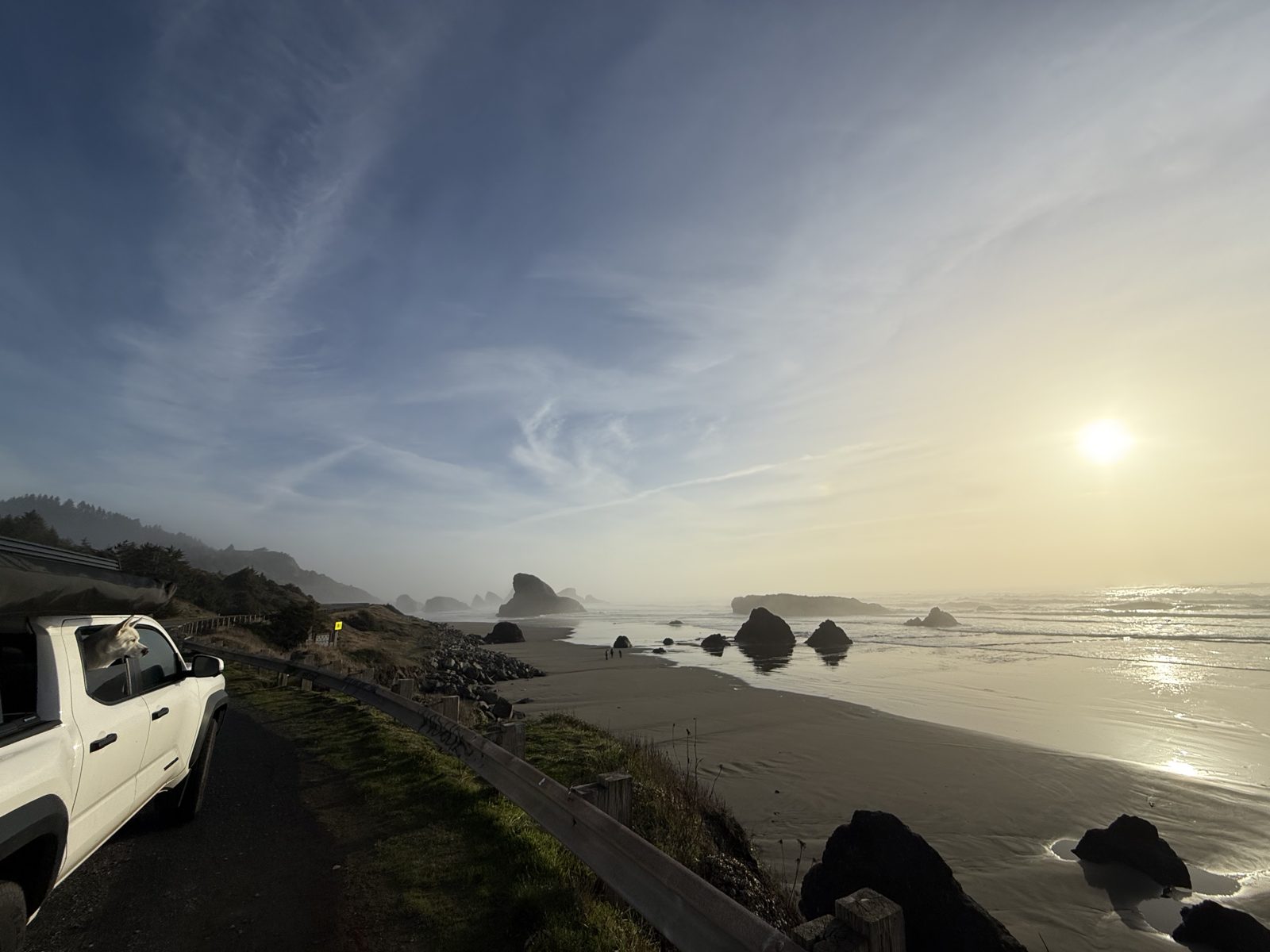
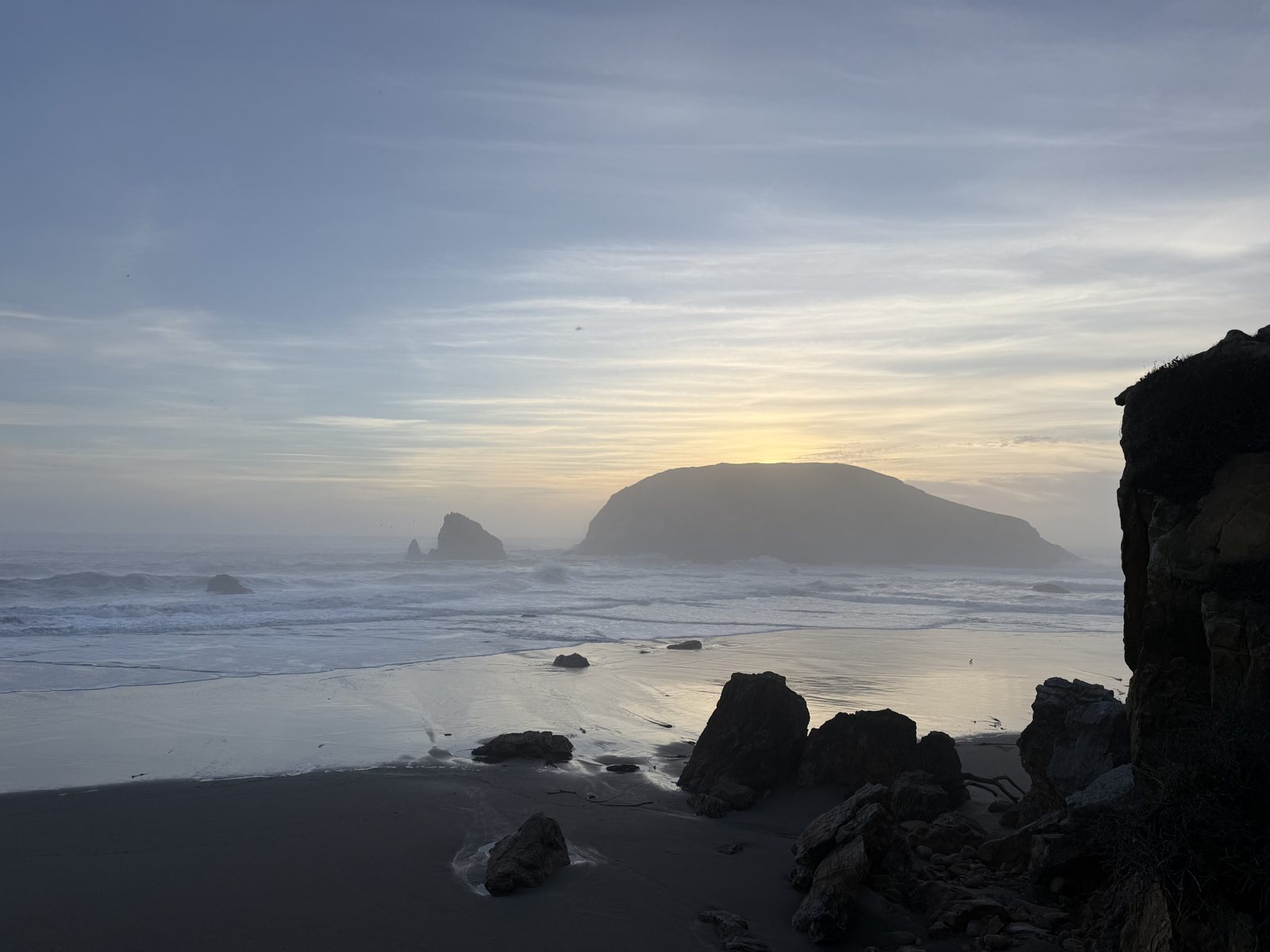
Then we came to the black-sand beaches, with the sea stacks, the spray, and the sun coming through, and nobody else around. The Montana mountains and those valley sunsets are one thing, but this was truly magical. The dark sand is heavy minerals, mostly magnetite, chromite, and ilmenite, that the waves sort out from the lighter sand, and in 1852, miners found gold mixed into it, which is how Gold Beach got its name.
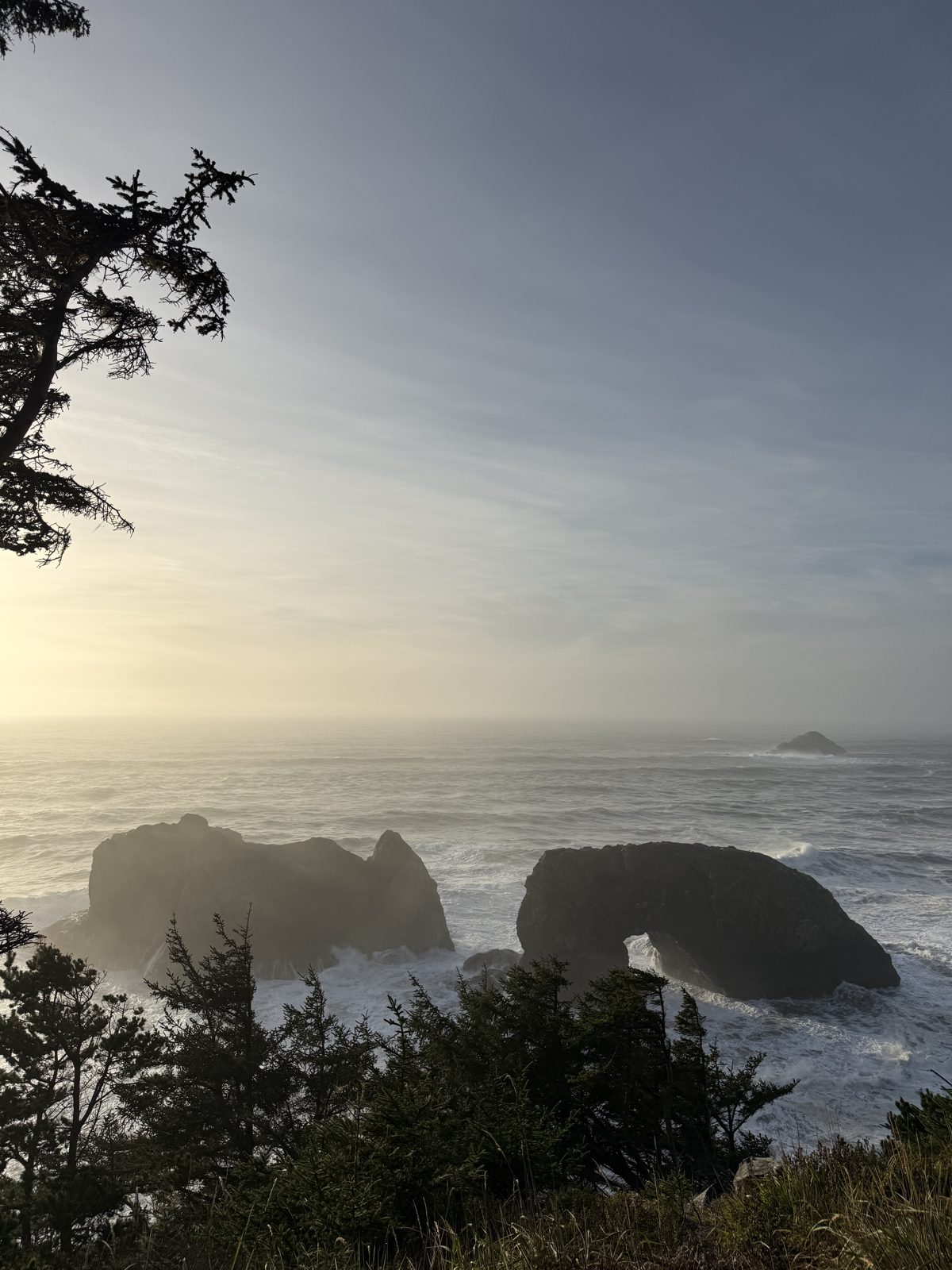
We made the Samuel H. Boardman corridor just before sunset, about 12 miles of coast named for Oregon's first state parks superintendent, and stopped at Arch Rock and the Natural Bridges with the sun dropping behind the stacks. We watched it go down over the water in Brookings.
Rhea
Half a pill in the morning, and Rhea was a happy girl on the back roads, bouncing from window to window with her tail up and taking in all the smells. On Route 42, she settled in and chilled in the back with her head out the window.
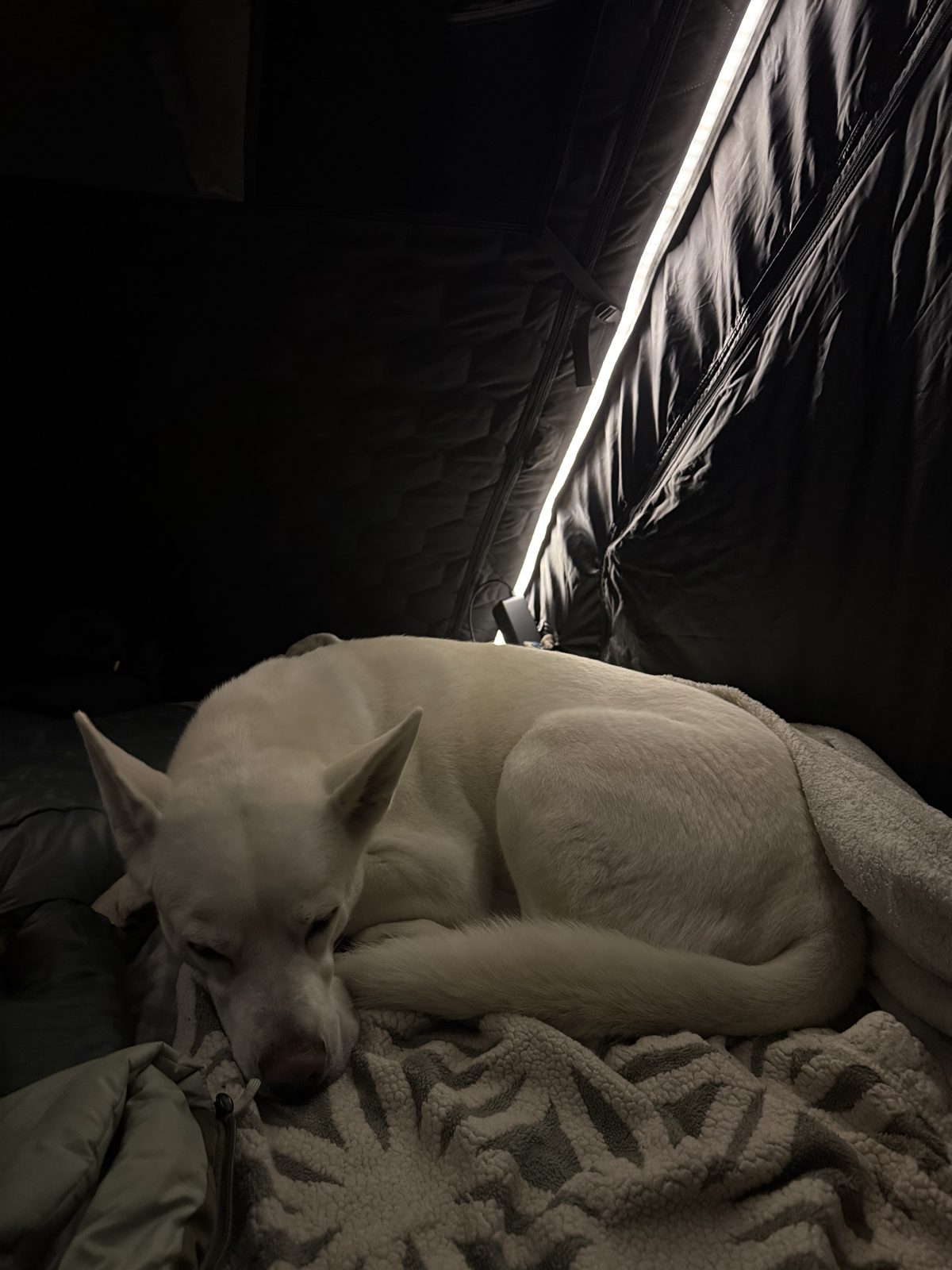
She took a long nap in the back seat at Battle Rock, curled up in a ball. We're on Rhea time, that's for sure, and a slow Sunday afternoon suited us both.
Comments and suggestions
No notes yet. Be the first.