
Can your dog actually hike here?
Can dogs hike in Fort Abraham Lincoln State Park?
Yes Yes. A leashed dog can use the trails.
Listen: the history of Fort Abraham Lincoln State Park
About 4 minutes, in five chapters. Tap a paragraph to start there.
DownloadOpen
Two rivers meet below this bluff, the Heart and the Missouri. On the slope above them stand earthlodges, the kind of permanent homes the Mandan lived in, and on the hill behind them stand three rebuilt blockhouses from an Army post. This is Fort Abraham Lincoln State Park, where a Mandan village and the fort that sent Custer to the Little Bighorn share one hillside.
Before the park
The Mandan built a village here around fifteen seventy-five. They named it On-A-Slant, because it sat on a plain sloping toward the river.
In seventeen eighty-one smallpox nearly wiped out the Heart River Mandan, and the survivors moved about forty miles upriver. When William Clark passed in October of eighteen oh four, he wrote of "an old remains of a villige on the Side of a hill".
The Mandan call themselves Nueta. With the Hidatsa, who call themselves Hiráaca, and the Arikara, who are the Sahnish, they govern together as the Mandan, Hidatsa and Arikara Nation, from New Town on the Fort Berthold Reservation. Lakota and Dakota people govern at Standing Rock, from Fort Yates, where the Lakota language is being revitalized.
The outsiders who stayed came for a railroad. The Army arrived in June of eighteen seventy-two with an infantry post, renamed Fort Abraham Lincoln that November. The Northern Pacific Railway reached Bismarck the next summer, and the tribes resisted it but could not stop the building.
Making the park
In eighteen seventy-three Congress authorized a cavalry post here, and within a year it was one of the largest forts on the northern plains, about six hundred fifty men. Its first commander was Lieutenant Colonel George Armstrong Custer of the Seventh Cavalry. In eighteen seventy-four he led the regiment into the Black Hills, an expedition that confirmed rumors of gold and led to the breaking of the treaty with the Sioux.
Once the railroad reached Montana the fort mattered less, and the Army decommissioned it in eighteen ninety-one. Settlers took the buildings apart for their own homes and farms.
The state park came in nineteen oh seven, the oldest in North Dakota. In the nineteen thirties the Civilian Conservation Corps, crews of young men who built much of the park, laid its roads and campground and rebuilt the blockhouses and five earthlodges. Custer's house went back up on its old site in nineteen eighty-nine, paid for by volunteers.
One story
In May of eighteen seventy-six, forty Arikara men enlisted here as soldiers, at thirteen dollars a month.
On the morning of May seventeenth, the band played Garryowen, the regiment's marching tune, one last time for Custer as the Seventh Cavalry rode out. His wife, Libbie, rode with the column as far as the Heart River and came back the next day. It was the last time she saw her husband alive. She wrote later that with his departure her last happy days in garrison were ended.
At the Little Bighorn, twenty-two of the Arikara crossed the river with Major Reno. Their war chief, Bob-tailed Bull, was killed there, with Little Brave and the scout Bloody Knife.
The news came back by river. On the evening of July third, Captain Grant Marsh took the steamboat Far West away from the mouth of the Little Bighorn, with the wounded aboard. He reached Bismarck at about eleven at night on July fifth, some seven hundred miles in fifty-four hours. He carried word that Custer, fourteen other officers and two hundred thirty-seven enlisted men were dead. The telegraph operator spent twenty-two hours sending it out to the world.
Fifty-four hours on the river, to carry that news home.
Today
The state counts this among its most-visited parks. Six earthlodges stand on the slope now, among them a large council lodge.
How to tell Custer's story is still argued here, and the park says it is working toward telling all sides of it. At the rebuilt house's thirtieth anniversary, Gerard Baker, a Hidatsa man and a former assistant director of the National Park Service, said some old-timers are still very upset by what Custer did to Indian people. "But it's history," he said, "and as long as we know that, we never want history to repeat itself".
One trail is named for Young Hawk, an Arikara scout who fought at the Little Bighorn and lived to tell it. From the main road, look for the earthlodges on the slope above the two rivers. This is Fort Abraham Lincoln State Park.
Sources
Open
- Fort Abraham Lincoln State Park. North Dakota Parks and Recreation Department, read 2026-10-17
- Fort Abraham Lincoln State Park, history. North Dakota Parks and Recreation Department, read 2026-10-17
- Part 5: The Frontier Army. State Historical Society of North Dakota, ND Studies, read 2026-10-17
- Fort Abraham Lincoln State Park map and visitor guide. North Dakota Parks and Recreation Department, read 2026-10-17
Before the park
- Fort Abraham Lincoln State Park. North Dakota Parks and Recreation Department, read 2026-10-17
- Fort Abraham Lincoln State Park. National Park Service, Places, read 2026-10-17
- Fort Abraham Lincoln State Park, history. North Dakota Parks and Recreation Department, read 2026-10-17
- On-A-Slant Village. National Park Service, Places (Lewis and Clark National Historic Trail), read 2026-10-17
- History. Mandan, Hidatsa and Arikara Nation, read 2026-10-17
- Language (Nűeta róota! Hiráaca íire! Speak Arikara). Mandan, Hidatsa and Arikara Nation, read 2026-10-17
- About TAT-MHA Nation. North Dakota Indian Affairs Commission, read 2026-10-17
- About Standing Rock Sioux Tribe. North Dakota Indian Affairs Commission, read 2026-10-17
- Section 2: The Northern Pacific Railway in North Dakota. State Historical Society of North Dakota, ND Studies, read 2026-10-17
Making the park
- Fort Abraham Lincoln State Park. North Dakota Parks and Recreation Department, read 2026-10-17
- Fort Abraham Lincoln State Park, history. North Dakota Parks and Recreation Department, read 2026-10-17
- Part 5: The Frontier Army. State Historical Society of North Dakota, ND Studies, read 2026-10-17
- Fort Abraham Lincoln State Park map and visitor guide. North Dakota Parks and Recreation Department, read 2026-10-17
- Garryowen (Dakota Datebook, Carole Butcher, 2022-06-02). Prairie Public, read 2026-10-17
- 30th anniversary of the restored Custer House (Dave Thompson, 2019-07-08). Prairie Public, read 2026-10-17
- Custer House reconstruction 25th anniversary (2014-07-14). Prairie Public, read 2026-10-17
One story
- Part 5: The Frontier Army. State Historical Society of North Dakota, ND Studies, read 2026-10-17
- Garryowen (Dakota Datebook, Carole Butcher, 2022-06-02). Prairie Public, read 2026-10-17
- The Arikaras: Custer's 13th Company (John Koster, Wild West, June 2015). HistoryNet, read 2026-10-17
- Custer's Farewell (Dakota Datebook, Christina Sunwall, 2022-05-19). Prairie Public, read 2026-10-17
- The Far West Returns (Dakota Datebook, 2022-05-18). Prairie Public, read 2026-10-17
Today
- Fort Abraham Lincoln State Park. North Dakota Parks and Recreation Department, read 2026-10-17
- Fort Abraham Lincoln State Park map and visitor guide. North Dakota Parks and Recreation Department, read 2026-10-17
- 30th anniversary of the restored Custer House (Dave Thompson, 2019-07-08). Prairie Public, read 2026-10-17
- The Arikaras: Custer's 13th Company (John Koster, Wild West, June 2015). HistoryNet, read 2026-10-17
- Fort Abraham Lincoln State Park trails. North Dakota Parks and Recreation Department, read 2026-10-17
- Fort Abraham Lincoln State Park gets upgrades, park still accessible for recreation opportunities (2024-09-10). North Dakota Parks and Recreation Department, read 2026-10-17
Best for dogs
- Fort Abraham Lincoln State Park. North Dakota Parks and Recreation Department, read 2026-10-17
- Fort Abraham Lincoln State Park map and visitor guide. North Dakota Parks and Recreation Department, read 2026-10-17
- Fort Abraham Lincoln State Park trails. North Dakota Parks and Recreation Department, read 2026-10-17
- Limited Service Season. North Dakota Parks and Recreation Department, read 2026-10-17
- Preventing ticks and tickborne diseases in spring and summer (2026-05-04). North Dakota Health and Human Services, read 2026-10-17
Dogs
Leashed dogs are welcome in the campground and on the grounds, though not in the camping cabins.
Where dogs can go
The campground and the trails above the Missouri, on a leash.
Watch out for
Water and the comfort station shut off Oct 18.
Best for dogs
| Trail | Distance and shape | Surface and shade | Leash rule | Why for a big dog | The hazard |
|---|---|---|---|---|---|
| Young Hawk Interpretive Trail, from the Valley picnic shelter | One point one miles, a loop that starts and ends at the shelter | Grass, dirt or hard-packed single-track with manageable grades, through prairie and woodland; water only at the dog drinking station outside the Visitor Center | "Pets are welcome but must stay on a leash while in the state park." | A short loop past numbered history posts up to the three rebuilt blockhouses, with room to move and views over the rivers | Shared with horses and mountain bikes; ticks are active whenever it is above freezing, so check her coat after |
| Little Soldier Loop, from the Valley picnic shelter | One point eight miles, a loop that joins the Young Hawk trail | Grass, dirt or hard-packed single-track, prairie and woodland; no water on the trail | On a leash everywhere in the park | The longest easy loop near the shelter, with wide views of On-A-Slant Village and the Missouri and Heart rivers | Shared with horses and mountain bikes; ticks in the grass |
| Mato-tope Trail, around the campground | One point four miles, a loop along the Missouri and Heart rivers | Grass, dirt or hard-packed single-track, along the riverbanks; campground water shuts off in mid-October | On a leash everywhere in the park | Flat river walking close to the truck, and no horses on this one | Bikes share it; campground water is off for the season from mid-October, so carry hers |
| Scattered Corn Trail, Visitor Center to On-A-Slant Village | Zero point four miles, one way | Grass, dirt or hard-packed single-track; the dog drinking station sits outside the Visitor Center at the start | On a leash everywhere in the park | A short walk to the earthlodges with a drink waiting at the trailhead, and no horses | Bikes share it; the earthlodges are a historic site, so keep her on the path |
Skip: The camping cabins are closed to pets. The Roughrider Trail, twenty-two miles to Fort Rice, is an off-highway-vehicle trail and no place for a dog on a leash.
Nearby: No need to leave: the whole park takes leashed dogs, and the paved Mandan-Fort Lincoln Bike Trail runs from the park toward Mandan.
From the park's own pages; we correct it once we've walked it.
ND. On our route: Day 18. Rules change: check the park's own pet page before you go. Rhea is never boarded or kenneled; where she can't go, we find somewhere she can.
When Rhea was here
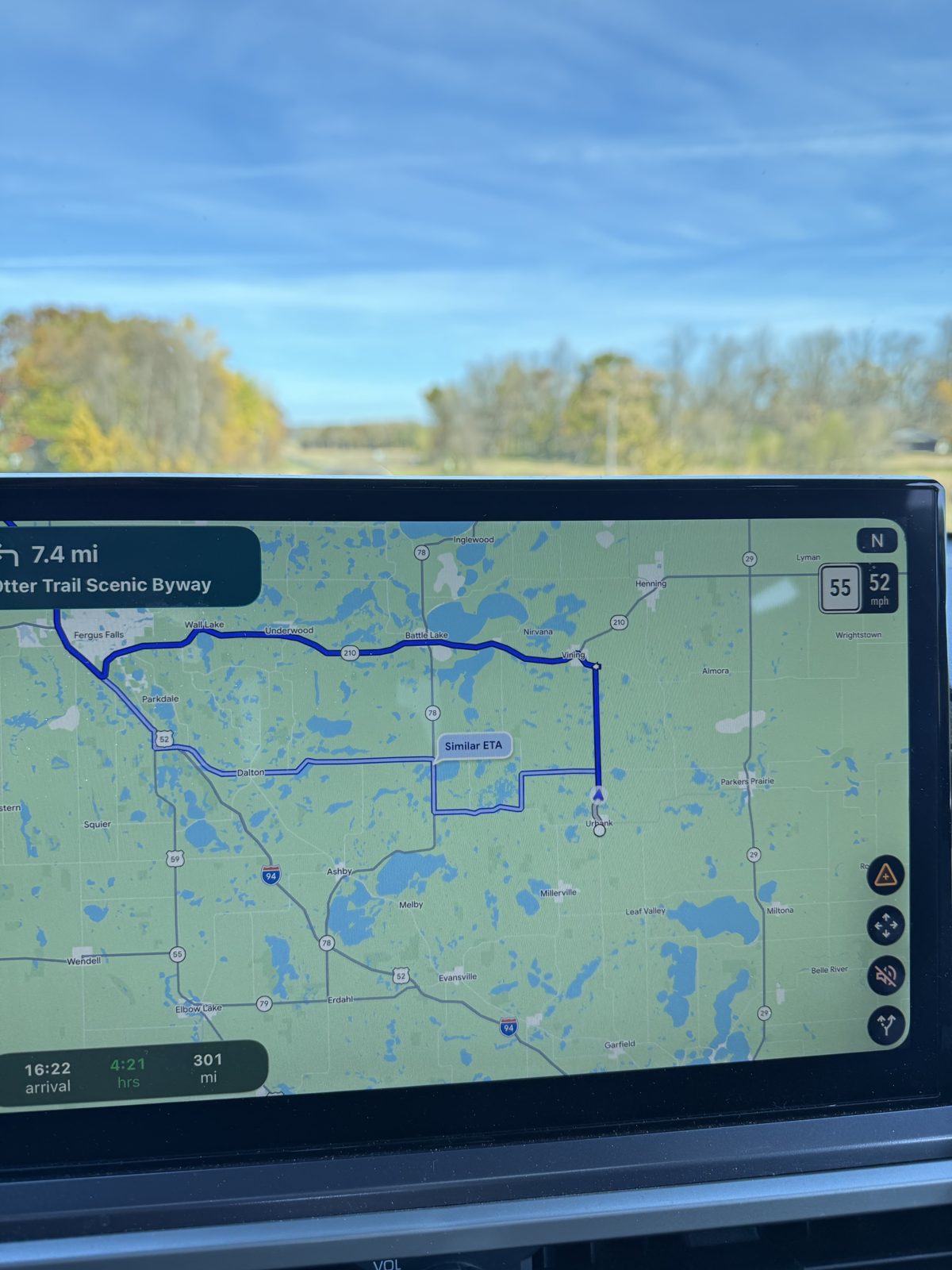
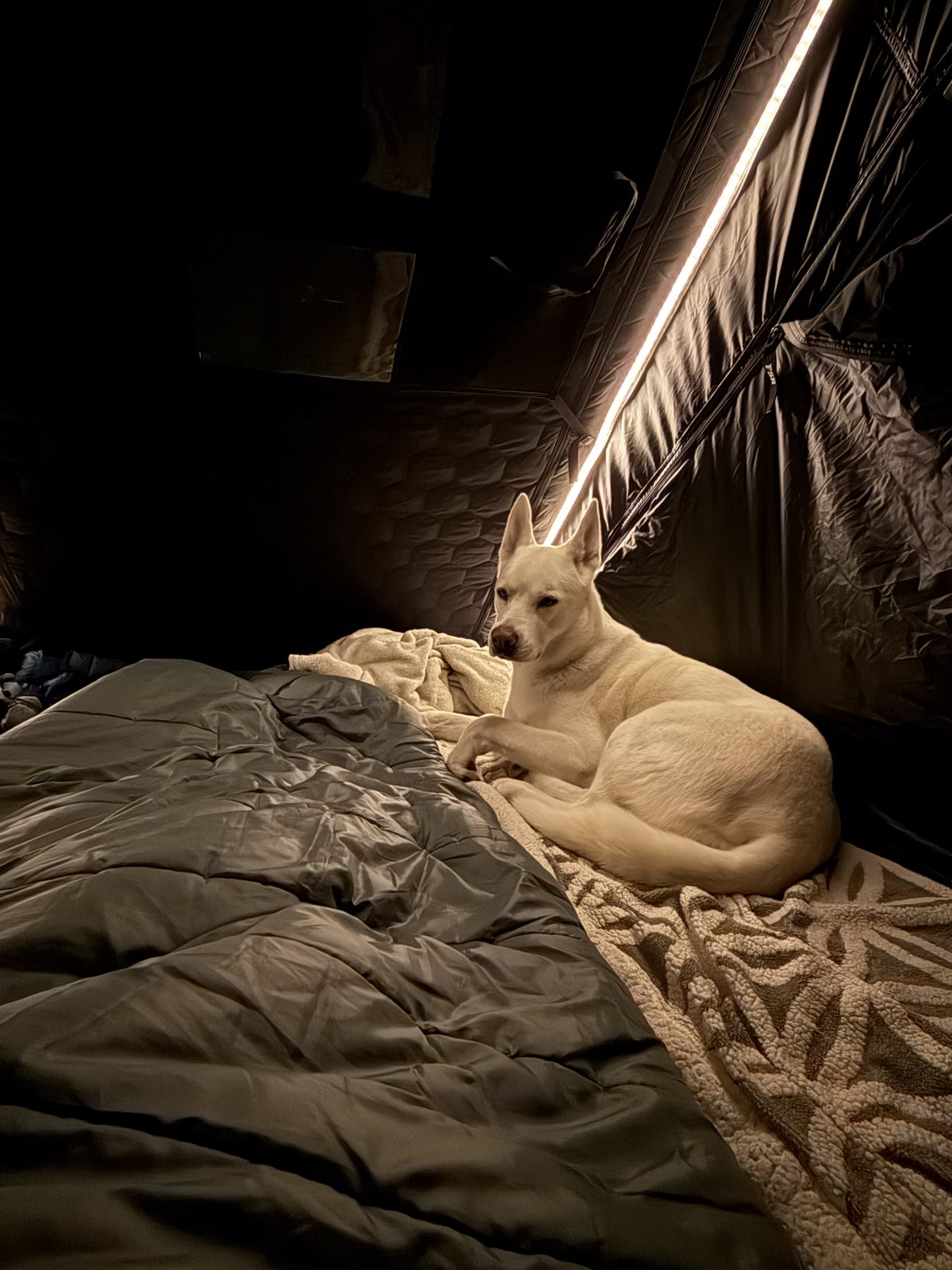
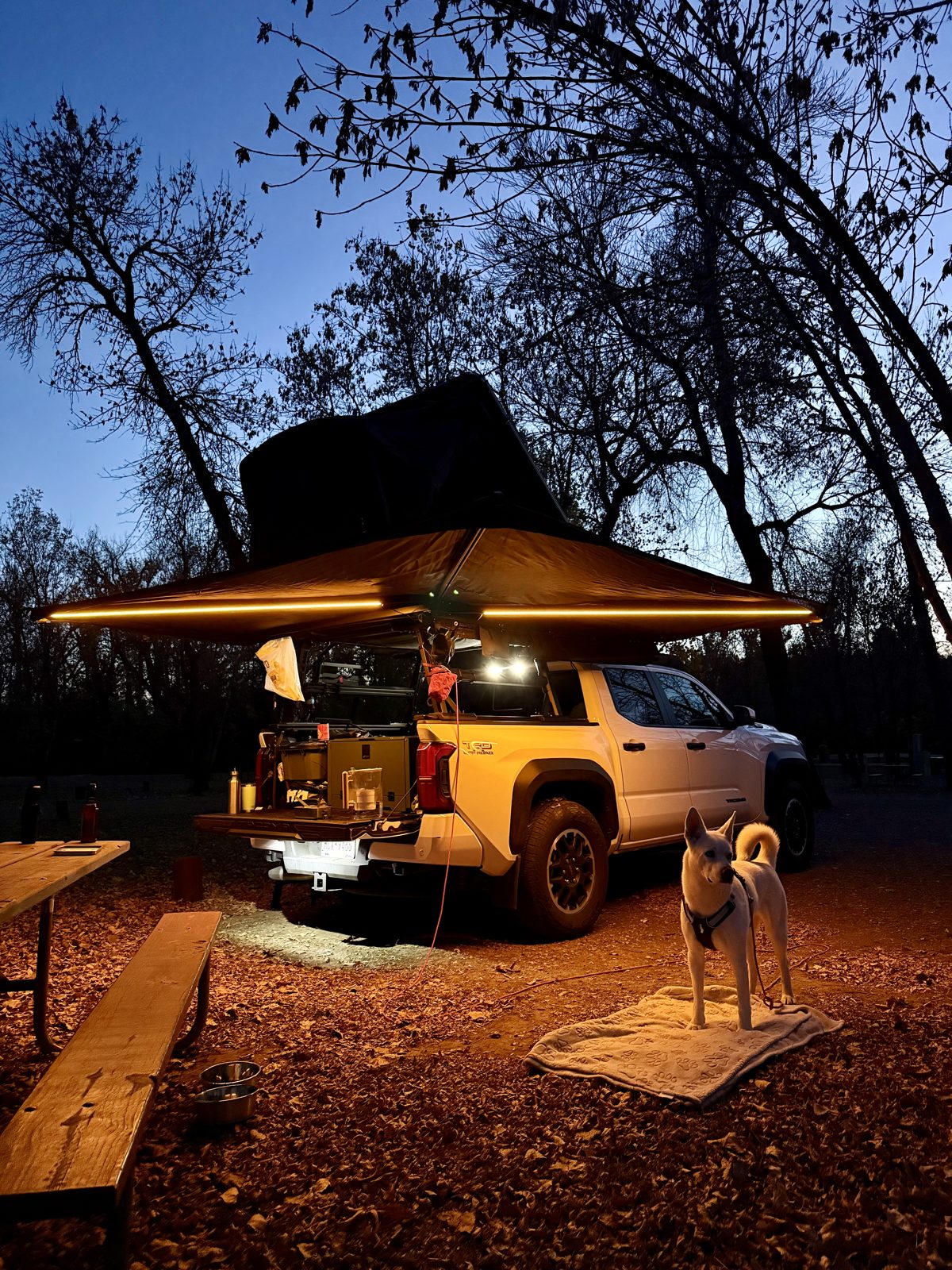
Day 18, Sun Oct 18. Read the day.
Been here with a dog? Which trail?
No notes yet. Be the first.