
Redwoods and Roosevelt Elk
Route
Tuesday, November 10th. My alarm woke me out of a deep sleep for an early call. I grabbed coffee supplies from the truck and noticed the whole sky was cotton candy pink. It was going to be a stellar day. I did a little work, cleaned up the room, showered, and shook the Rhea hair out of the truck while she ate and napped. With only a short drive ahead, we skipped the calming supplements and the trazodone entirely. It was a humid 60 degrees, and we were going to take our time in the redwoods.
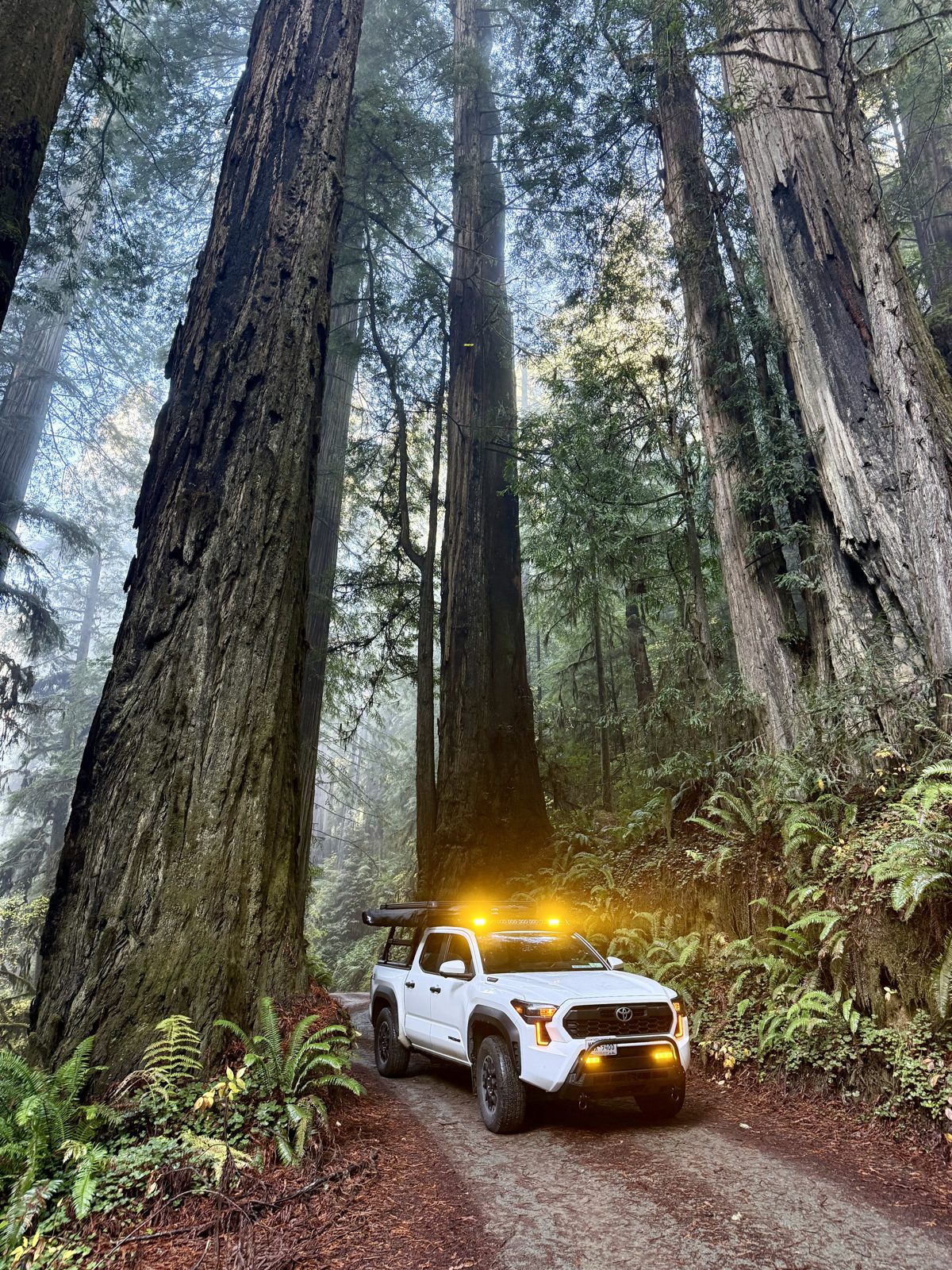
Howland Hill Road climbs into Jedediah Smith Redwoods State Park from the west, right outside Crescent City. At the base, there's a little rural community, maybe a half mile to a mile of houses on the edge of town, and then the road starts climbing, and you're in the park. At the north end after the drive, we could see homes across the Smith River, 200 or 300 yards from the trees. Imagine raising your kids with black-sand beaches on one side and some of the world’s oldest redwoods in your backyard. I'm envious.
Part of Howland Hill Road follows the old Crescent City Plank and Turnpike Road, finished in 1858 to carry stagecoaches and freight from the harbor to the gold camps in southern Oregon. Much of it is still dirt, maintained but with plenty of potholes.
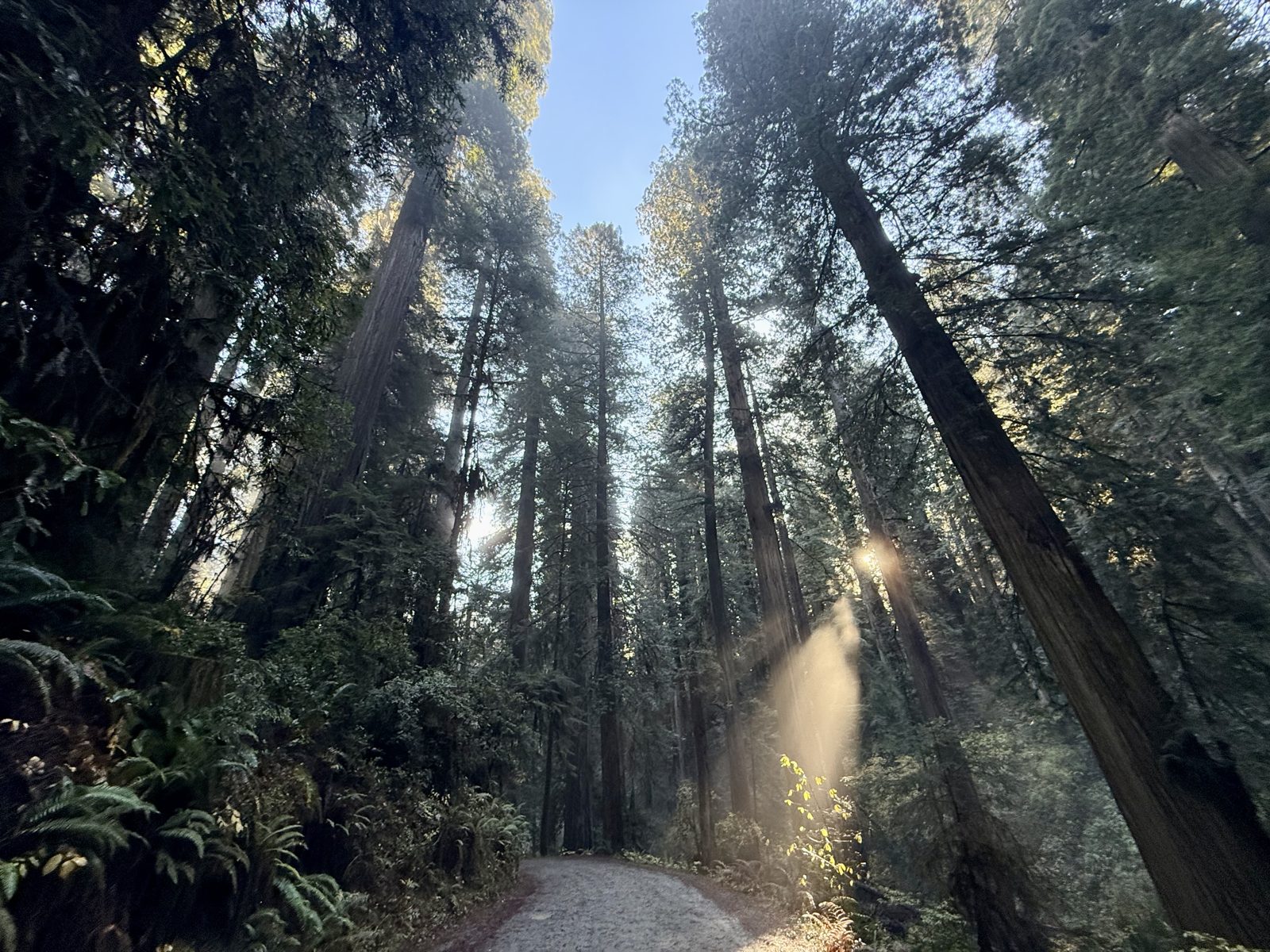
Entering from the west, you're met with behemoths. The trees line the road, 10 feet in diameter, maybe more, and the road winds right between them, so they must have taken real care not to damage them when they built it. I hopped out to touch the bark; it was as thick as the tree trunks back home. Up top, the crowns were still dripping with dew and mist from yesterday's rain, and ferns four, five, and six feet tall covered the forest floor. It was like driving through Jurassic Park. I had the sunroof open for a while but had to close it because so much water was dripping off the trees. It was raining inside the truck. Redwoods drink from the fog as well as the rain. Fog collects on their needles and drips to the ground, and in summer, that fog drip can make up as much as 45% of their water.
These trees are incredibly resilient. Some have their bases burned out and hollowed, with just the outer shell of the trunk still carrying water and nutrients up the tree. Their bark can be a foot thick and full of tannins, so fire and insects rarely finish them off, and early settlers called those hollows goosepens, because they kept their chickens and geese in them. Other trees had toppled over or sheared off 50 feet up and were still sending green sprouts out the side. Every tree here is huge, and then you come up on a gargantuan one that puts all the others to shame.
This whole coast used to look like this. Originally, about 2 million acres of old-growth redwood grew here, and about 95% of it has been logged. It's sad, but it's so breathtaking in this moment.
We had the road to ourselves. We passed a couple of cars and a few more parked at trailheads, but I could stop in the middle of the road whenever I wanted, get out, and take pictures. If you can, come see the redwoods in the off-season, without the crowds and the noise. It's just you and the stillness.
To get back to Crescent City, we took US 199, the paved Redwood Highway, at 50 to 55 miles an hour. It runs through the same massive trunks as the dirt road, only faster, and it felt like something out of a video game.
Heading south on 101, we kept weaving through redwoods along the coast. Some are a couple hundred years old, and then you pass the big ones that must be well over a thousand. These trees hold a sense of history that's hard to put into words. They're the wise old great-grandparents of our time.
High up on 101, we could see the ocean in bands of color. Yesterday's rain was still pouring off the cliffs and mountains, and for the first 100 or 200 yards out, the water was brown and murky with mud. Past that, it turned a lighter turquoise for several hundred yards, and then deeper and deeper blue.
Near the mouth of the Klamath River, we took a scenic coastal dirt road with stunning views. Up on the hillside, we passed what looked like an old farmhouse and a barn. They're actually Radar Station B-71, an early-warning station from World War II, built in late 1942. The farmhouse is concrete block dressed up with fake windows and dormers, and the barn hid the operations building. About 35 men ran it around the clock, and it's one of the few WWII radar stations still standing in the country. Like the one back home in Montauk, only much smaller.
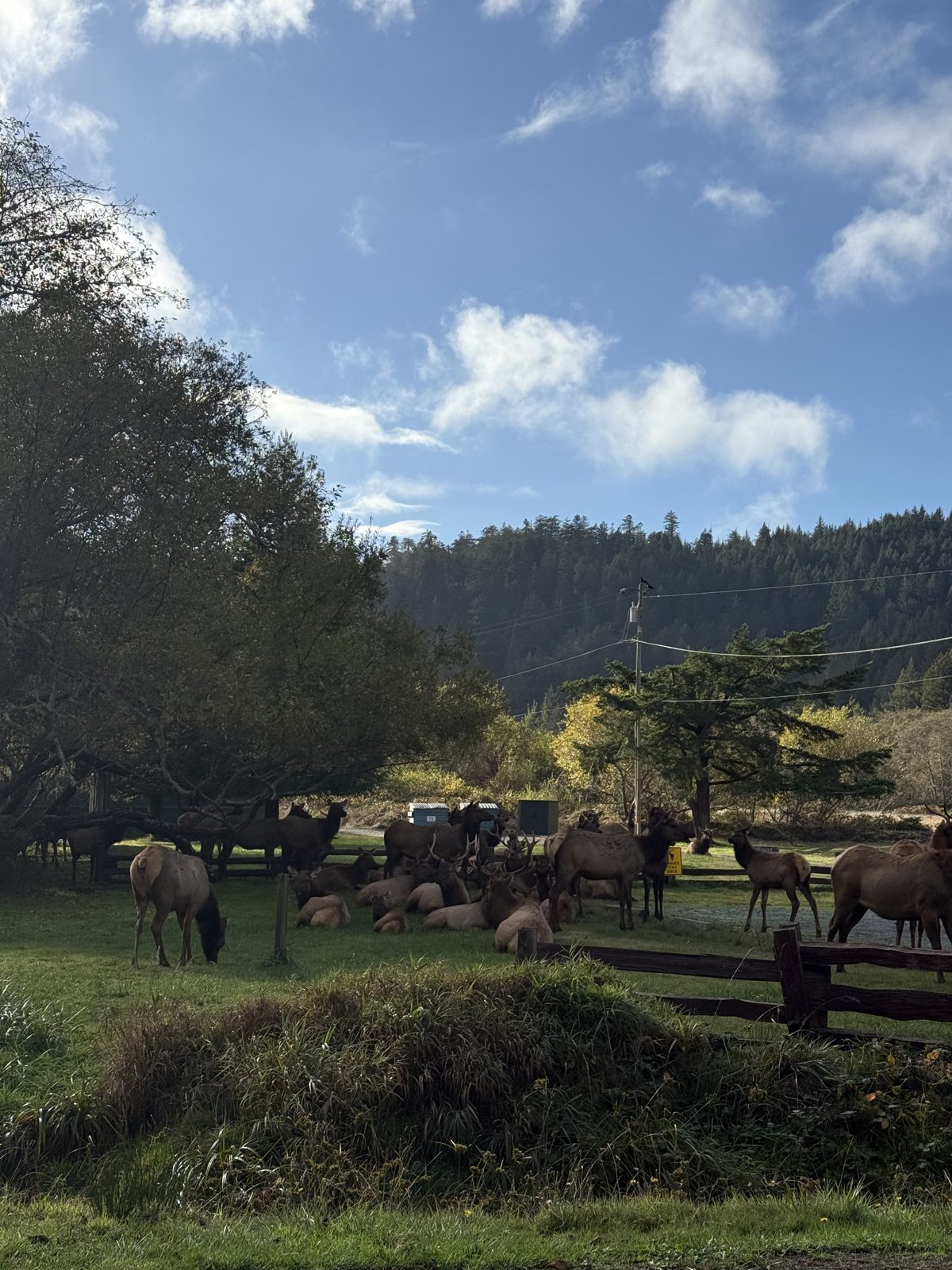
Farther south, an entire herd of Roosevelt elk lounged on a lawn by the road: a couple of big bulls, some younger ones, and a lot of cows, some of them lying down for naps. We pulled over for pictures while Rhea lost her mind in the back seat, per usual. Roosevelt elk are the largest elk in North America, named for Teddy Roosevelt, and by 1925, as few as 15 were left in all of California. One of the last herds was right here at Prairie Creek.
Steinbeck kept the redwoods a secret from Charley in 1960, saving him for one perfect tree, a 300-foot "grandfather" by a stream. Charley ignored it. Rhea had eyes only for the elk.
After a stop at a little recreation area to run off some of her energy, we took the dirt road five miles in to Gold Bluffs Beach, through more redwoods and walls and walls of ferns. The trees aren't as big as the morning's, but Rhea loved it, with her head out the window the whole way. In 1850, a party heading north from Trinidad spotted gold in the beach's black sand, and by early 1851, thousands of men had landed at Trinidad to strike it rich. The gold was too fine to separate, and the camps were empty by that summer. We drove all the way to the end of the beach, and it's stunning out there, but it's a long dirt road in and a long dirt road back.
I'd thought about camping right on the beach, but we'd have been covered in salty mist, so we camped back at Prairie Creek instead, on the far edge of a huge pasture where the elk come to graze. Signs everywhere say not to approach the elk on foot. We got into camp at 4:30, and the sun set at 5. As soon as the air went still, tiny gnats came out of nowhere and swarmed us, and a mosquito the size of my thumb landed on my leg and bit me right through my jeans. Thank God a little breeze kicked up and kept them away. Moisture falls out of the air fast here; I'd put my blankets out to air out a bit, but they only got damp. Dinner was farro, broccoli, and steak, and we were up in the tent before 7. We're a little inland, with a good stand of redwoods between us and the ocean, but we could still hear the waves roaring in the distance. It's a simple life out here.
Rhea
With no meds in the morning, Rhea rode happy through the redwoods. Later on 101, I gave her a calming treat, and our windows-up routine kept her from going out the window after the elk.
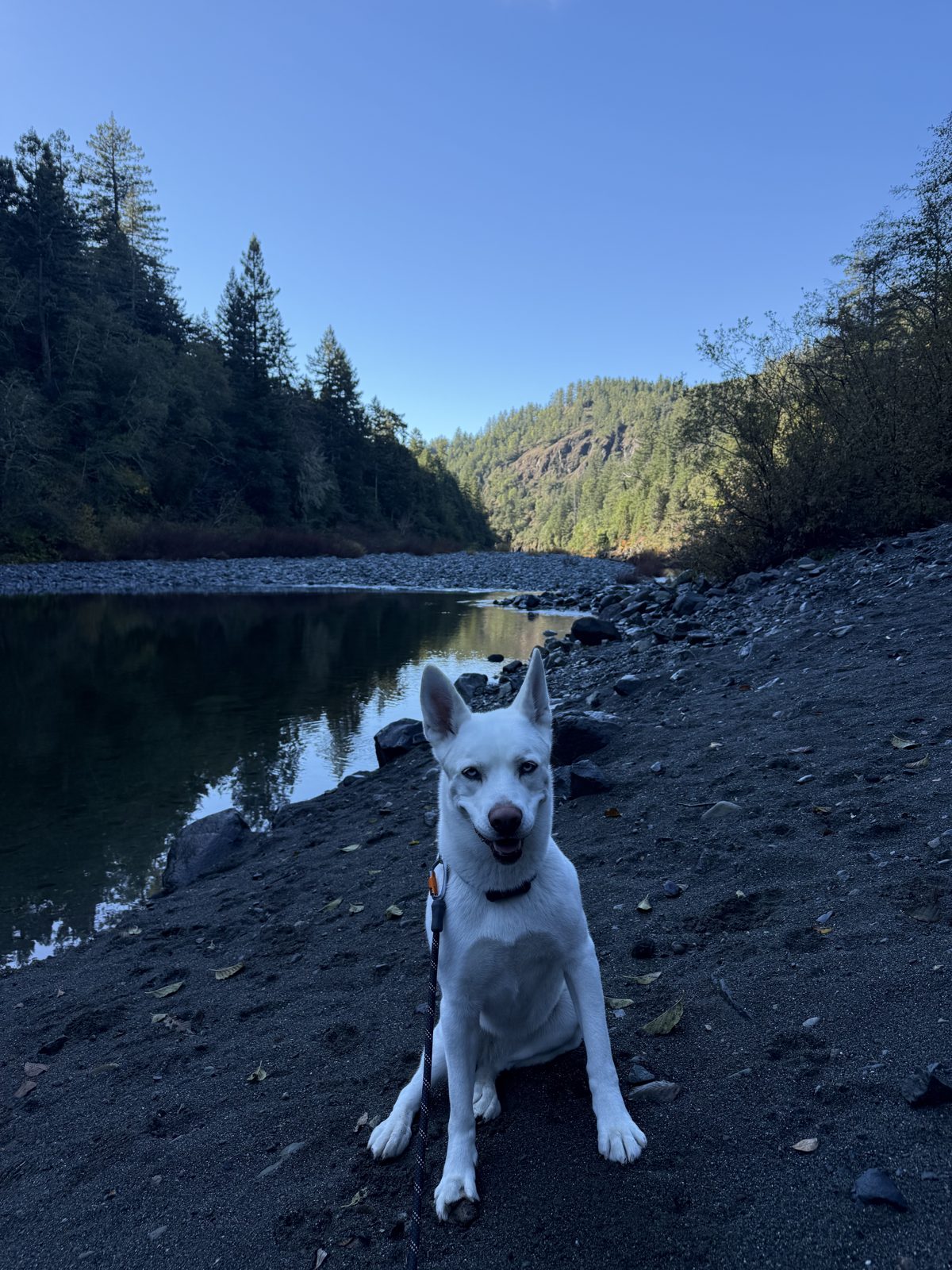
She does this thing in the back seat that I love. When we're pulled over and I'm working, she'll wake up from a nap and, without even standing up, lift her head and sniff the air for a good while to figure out where we are and what's going on. Then she puts her head back down and goes right back to sleep. Dogs have up to 300 million scent receptors in their noses, compared with about six million in ours, so a few sniffs tell her everything she needs to know.
At camp, she had some lean grass-fed raw beef with her dinner, and then she was all amped up on the bunnies in the pasture. After dark, two bucks with big racks walked out of the darkness, and Rhea was locked in. Crouching tiger, hidden Rhea. I got it on video, and I was very glad she was on her lead, because those racks could have done some damage. Later, she tore off after something in the pasture, and her long lead caught our little kitchen and knocked it over. I yelled, and she came right back and sat down in front of me, smiling and wide-eyed, as if to say, "See? I'm sitting. Now let me go chase it." All she wants is to please me. And to murder things.
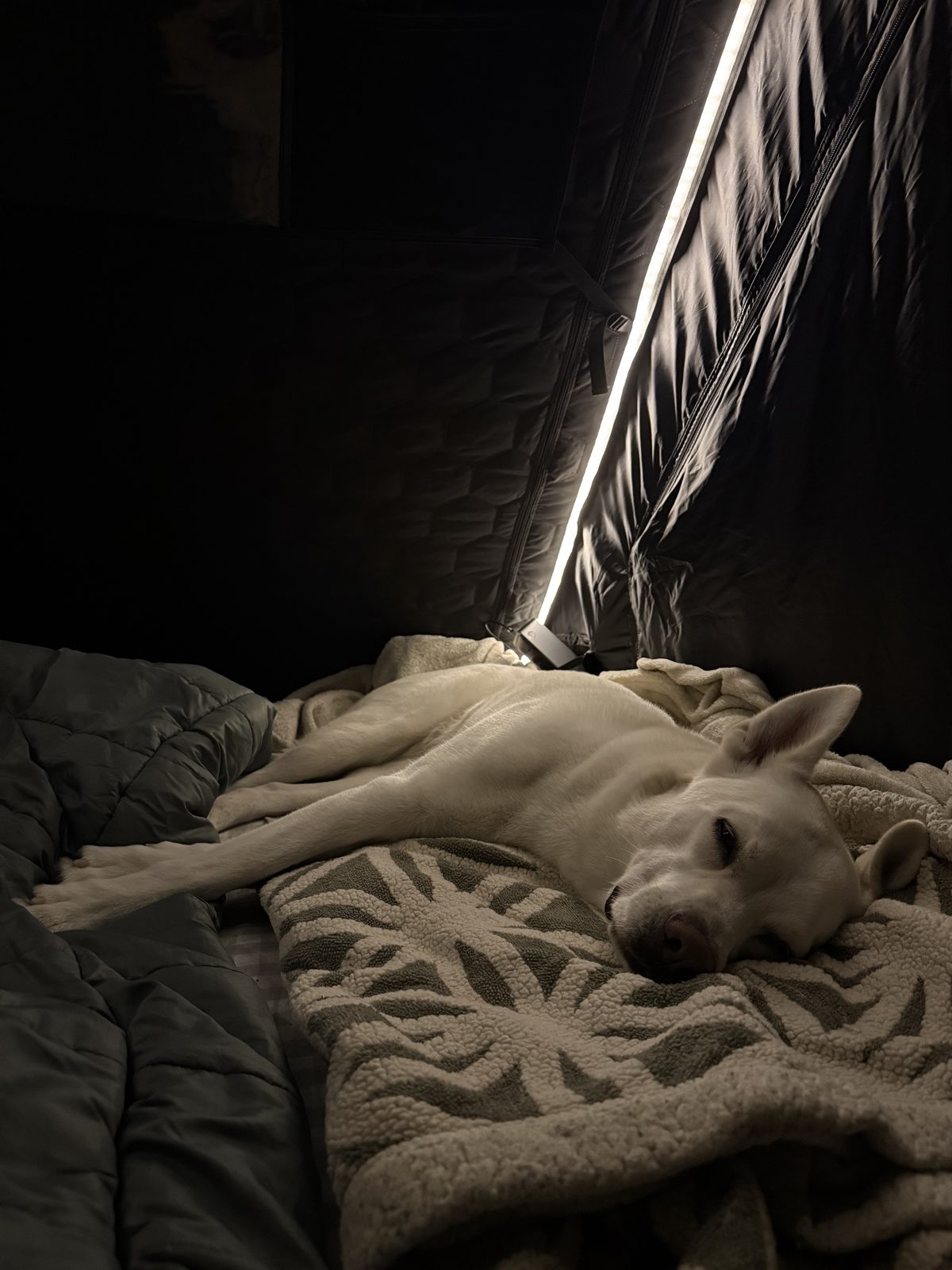
No sound is sweeter to fall asleep to than the waves rumbling in the distance and Rhea's deep breathing right next to me.
Comments and suggestions
No notes yet. Be the first.