
Can your dog actually hike here?
Can dogs hike in Yellowstone National Park?
No No. Dogs stay off the trails.
Listen: the history of Yellowstone National Park
About 4 minutes, in five chapters. Tap a paragraph to start there.
DownloadOpen
In eighteen seventy-two, Congress drew a line around this high country of geysers and hot springs and set it apart as a public park, for the benefit and enjoyment of the people. It was the first national park in the world. It covers more than two point two million acres, nearly all of it in Wyoming, with thin edges in Montana and Idaho. This is Yellowstone National Park.
Before the park
People have lived and traveled here for more than eleven thousand years. For all that time they came to a black wall of volcanic glass, Obsidian Cliff, and chipped it into arrowheads and spear tips. Some tribes traveled roughly two thousand miles to reach it, and points made from its glass have turned up as far east as Ohio and Ontario.
The Crow held the country east of the park, and the Blackfeet the country to the north. The Crow's own name for themselves means children of the large-beaked bird. Shoshone, Bannock and Nez Perce people used this land as well.
A band of Mountain Shoshone called the Sheep Eaters lived inside what became the park for thousands of years. They hunted on foot with dogs that looked like both wolves and huskies, and the dogs hauled travois, two-pole sleds loaded with game. An early superintendent spread the false story that the tribes feared the geysers, part of the push to move them out. By the late eighteen hundreds the Sheep Eaters had been forced onto reservations.
Today the Eastern Shoshone Tribe governs itself on the Wind River Reservation in Wyoming. The Shoshone-Bannock Tribes hold the Fort Hall Reservation in Idaho, cut by a survey error from one point eight million acres to one point two million. The Nez Perce Tribe calls its people the Nimiipuu. The park counts twenty-seven tribes with ties to this land.
Making the park
A small party of explorers came in eighteen sixty-nine, and a larger one in eighteen seventy named Old Faithful. One of its leaders, Nathaniel Langford, then lectured across the country on a publicity tour for the Northern Pacific Railroad. His talk in Washington moved Ferdinand Hayden to survey the region in eighteen seventy-one. Hayden brought back photographs by William Henry Jackson and paintings by Thomas Moran, and they caught the imagination of Congress.
On March first, eighteen seventy-two, President Ulysses Grant signed the law. It withdrew the land from settlement and sale and dedicated it as a pleasuring-ground for the people.
The law had no teeth. In eighteen eighty-six the Army arrived to run the park, and it stayed more than thirty years. In eighteen ninety-four, soldiers caught a man slaughtering bison, and there was no law to punish him. A journalist wired the story to Forest and Stream, and within two months Congress passed one. The stone buildings of Fort Yellowstone, the old Army post, have been the park's headquarters since nineteen eighteen.
One story
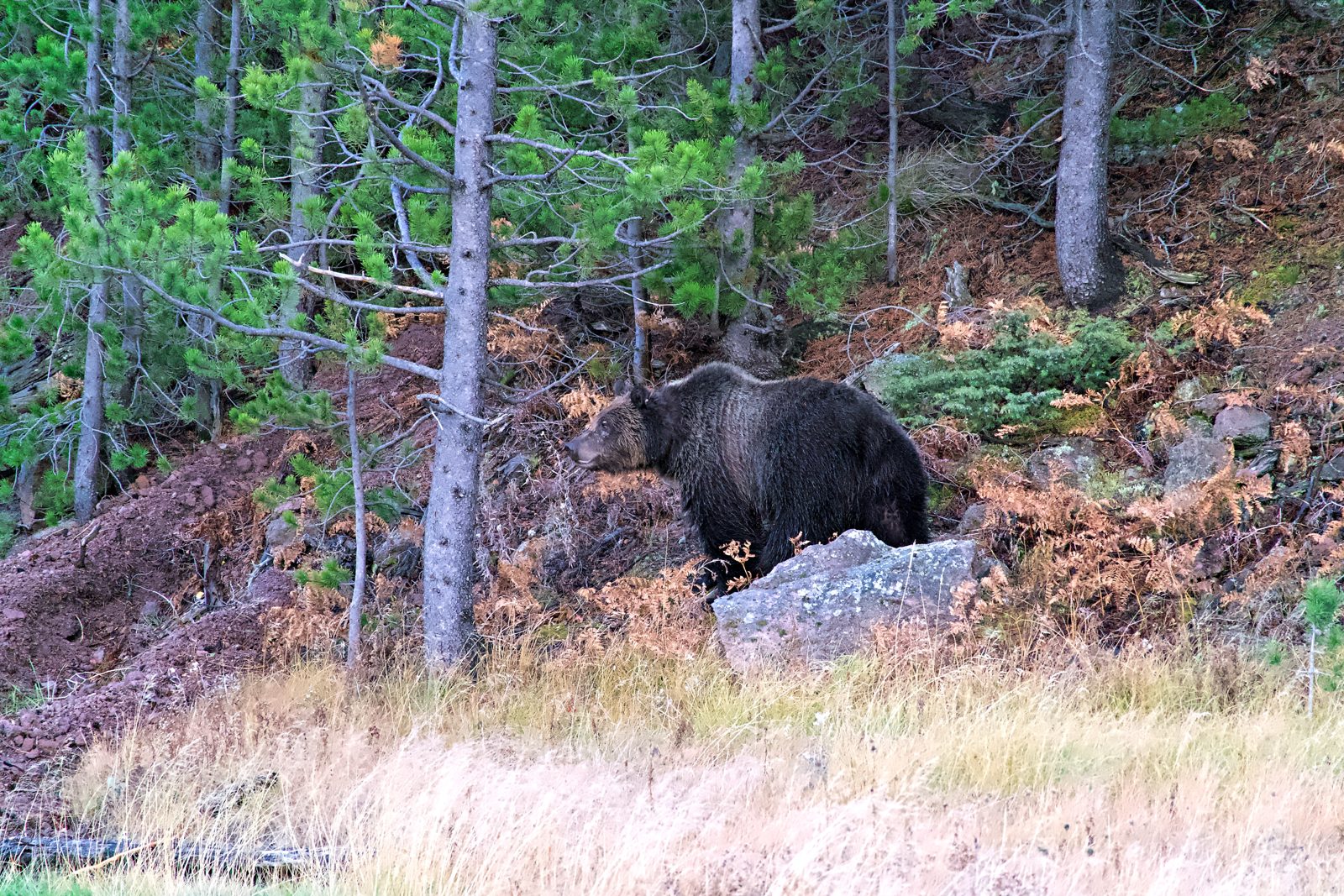
For decades, the bears of Yellowstone worked the roads. Visitors fed them along the roadsides. Beginning in nineteen thirty-one, the park counted an average of forty-eight people hurt by bears every year.
In nineteen sixty, the park started a bear program that banned the feeding. That October, the writer John Steinbeck drove in at the north entrance with his dog, Charley, on the trip that became the book Travels with Charley. Charley, normally gentle, went wild at every roadside bear, so Steinbeck turned around and left the park.
The feeding ended, and the dumps went next. In nineteen seventy the park began closing its open garbage dumps. Injuries fell from forty-five a year in the nineteen sixties to about one a year in the two thousands. Forty-eight a year, down to one.
Today
Nearly four point eight million visits came in twenty twenty-five. In June of twenty twenty-two, a five-hundred-year flood tore out the north entrance road in several places, and traffic now runs on the park's original entrance road, from eighteen seventy-nine.
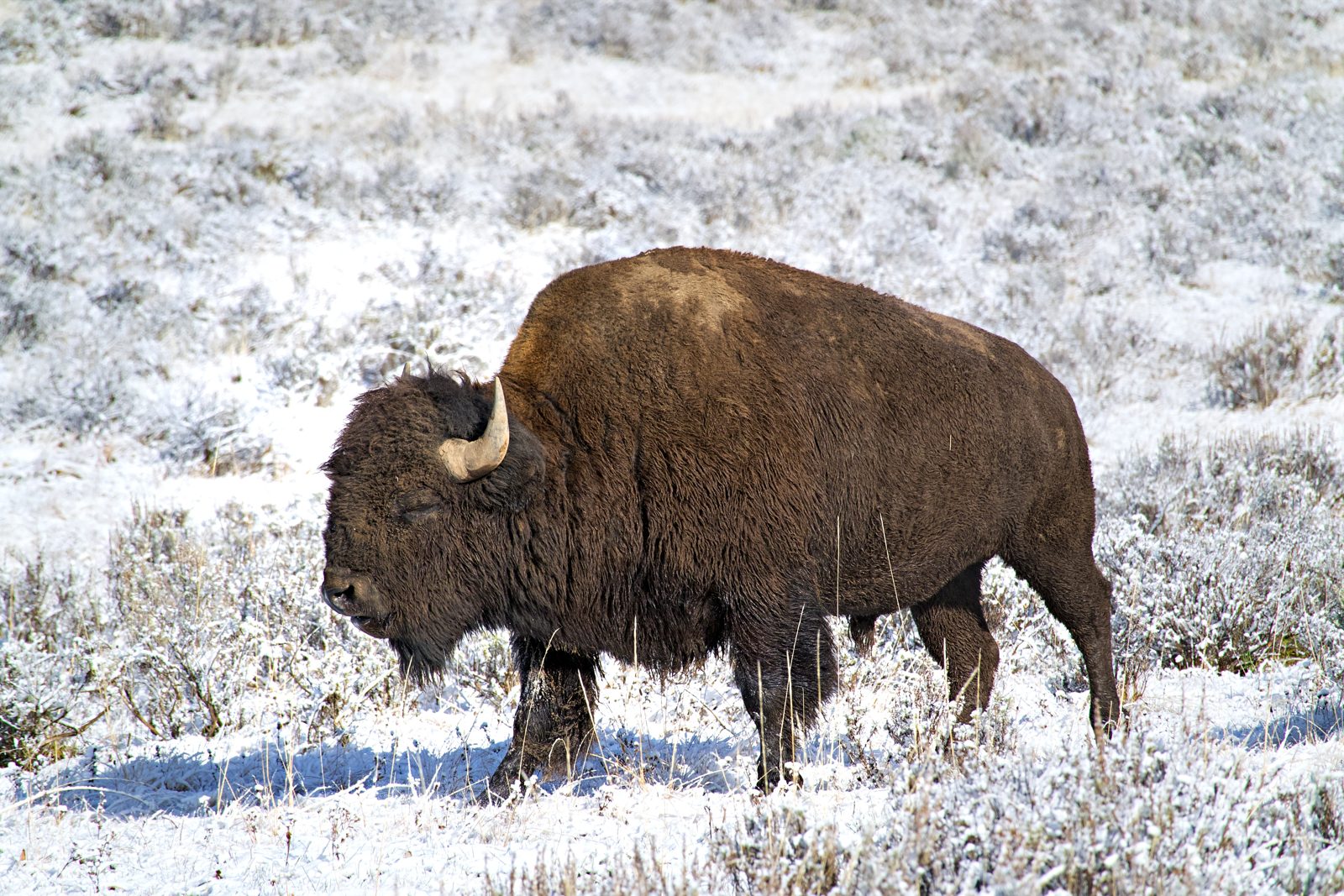
The bison came back from the edge. By the late eighteen eighties about two dozen were left in the wild here, and the latest count is nearly fifty-three hundred. How many the land should carry is still argued: Montana sued over the park's bison plan, arguing for fewer bison, then moved to drop its suit in September of twenty twenty-six, and one other case is pending.
At the north entrance, look for the stone arch whose cornerstone Theodore Roosevelt laid in nineteen oh three. It carries the words of the law: For the benefit and enjoyment of the people. This is Yellowstone National Park.
Sources
Open
- Birth of a National Park. Yellowstone National Park, NPS, read 2026-10-14
- Park Facts. Yellowstone National Park, NPS, read 2026-10-14
Before the park
- Associated Tribes. Yellowstone National Park, NPS, read 2026-10-14
- Historic Tribes. Yellowstone National Park, NPS, read 2026-10-14
- The Tukudika Indians. Yellowstone National Park, NPS, read 2026-10-14
- "Land of the burning ground": The history and traditions of Indigenous people in Yellowstone (Yellowstone Caldera Chronicles, July 25, 2021). USGS Yellowstone Volcano Observatory, read 2026-10-14
- Shane Doyle, "Public lands were homelands for the Crow Nation" (Nov 28, 2019, updated June 22, 2025). Montana Free Press / Mountain Journal, read 2026-10-14
- About Us. Shoshone-Bannock Tribes, read 2026-10-14
- Eastern Shoshone Tribe. Eastern Shoshone Tribe, read 2026-10-14
- About. Nez Perce Tribe, read 2026-10-14
Making the park
- Timeline of Human History in Yellowstone. Yellowstone National Park, NPS, read 2026-10-14
- Birth of a National Park. Yellowstone National Park, NPS, read 2026-10-14
- Expeditions Explore Yellowstone. Yellowstone National Park, NPS, read 2026-10-14
- The Superintendents: Nathaniel Langford. Yellowstone National Park, NPS, read 2026-10-14
- Fort Yellowstone. Yellowstone National Park, NPS, read 2026-10-14
- Fort Yellowstone Guardhouse. NPS, read 2026-10-14
One story
- History of Bear Management. Yellowstone National Park, NPS, read 2026-10-14
- Steinbeck stories, stop 29 (Gardiner, MT), from Travels with Charley Part Three and Steigerwald. Travels with Rhea route notes
Today
- Timeline of Human History in Yellowstone. Yellowstone National Park, NPS, read 2026-10-14
- Birth of a National Park. Yellowstone National Park, NPS, read 2026-10-14
- Park Facts. Yellowstone National Park, NPS, read 2026-10-14
- History of Bison Management. Yellowstone National Park, NPS, read 2026-10-14
- Yellowstone National Park Sees 4,762,988 Visits in 2025 (news release, March 17, 2026). Yellowstone National Park, NPS, read 2026-10-14
- Flood Recovery. Yellowstone National Park, NPS, read 2026-10-14
- Bison Management. Yellowstone National Park, NPS, read 2026-10-14
- Fort Peck Tribes, Conservation Groups Move to Defend Yellowstone Bison Plan in Court (Feb 24, 2025). Earthjustice, read 2026-10-14
- Montana drops bison lawsuit against Yellowstone National Park (Sept 16, 2026). NBC Montana, read 2026-10-14
- Roosevelt Arch. NPS, read 2026-10-14
Best for dogs
- Park Facts. Yellowstone National Park, NPS, read 2026-10-14
- Pets. Yellowstone National Park, NPS, read 2026-10-14
- Safety. Yellowstone National Park, NPS, read 2026-10-14
- Favorite Fall Hikes Outside Yellowstone (Sept 6, 2022). Visit Gardiner, MT (Gardiner Chamber of Commerce), read 2026-10-14
- Eagle Creek Campground. Custer Gallatin National Forest, USDA Forest Service, read 2026-10-14
- 36 CFR 261.16, Developed recreation sites, paragraph (j). Legal Information Institute, Cornell Law School, read 2026-10-14
- Hiking. Visit Gardiner, MT (Gardiner Chamber of Commerce), read 2026-10-14
- Origins of the OTO. Custer Gallatin National Forest, USDA Forest Service, read 2026-10-14
Dogs
Dogs are banned from all trails, boardwalks and thermal areas and must stay within 100 feet of roads.
Where dogs can go
Roads, parking lots and campgrounds. Carrying or strollering her past the rules is banned too.
What we do instead
Paradise Valley and the Custer Gallatin National Forest just outside the park, where dogs can hike.
Where to take a dog instead
Skip: All of the park's trails, about eleven hundred miles of them, are closed to dogs. Pets are barred from boardwalks, hiking trails, the backcountry and thermal areas, and carrying her in your arms, a stroller or a backpack is banned there too. That rules out the boardwalks on the terraces at the north entrance, the Upper Geyser Basin around Old Faithful and the walk out to Grand Prismatic Spring. Where she can go: a car, the pullouts, parking lots and campgrounds, on a leash no longer than six feet, and never more than one hundred feet from a road, a parking area or a campground. That hundred-foot line is why the sage beyond a Lamar Valley pullout is off limits, however open it looks. The park says the rule protects pets from being killed by bears and coyotes or burned in the hot springs, where more than twenty people have died. Keep at least twenty-five yards from bison and elk, and one hundred yards from bears and wolves; bison have hurt more people here than any other animal.
Nearby: The Custer Gallatin National Forest wraps the park's north boundary around Gardiner, and dogs may hike its trails. Eagle Creek Campground, two miles northeast of Gardiner on Jardine Road at six thousand one hundred feet, is open all year, and the Yellowstone River Trailhead is inside it. That trail runs four to five miles round trip, moderate, with about eight hundred feet of elevation change: across high-mountain desert, then down the Bear Creek drainage to the river, with views of Electric Peak. Turn back at the park border, about two and a half miles in; past that line it is park trail, and a dog must stop at the boundary. Bears use this country: a food storage order runs from March first to December first, and every campsite has a bear box. In the campground, federal rules require a leash no longer than six feet. For more trails, the Gardiner Chamber lists others by number, among them Trail seventy-two from the Cedar Creek trailhead to the historic OTO Ranch, a dude ranch that began in eighteen ninety-eight with a squatter's cabin ten miles north of the park.
From the park's own pages; we correct it once we've walked it.
WY/MT. On our route: Day 24. Rules change: check the park's own pet page before you go. Rhea is never boarded or kenneled; where she can't go, we find somewhere she can.
When Rhea was here
Day 24, Sat Oct 24. Read the day.
Been here with a dog? Which trail?
No notes yet. Be the first.